|
Lego Shelf For Rocket 4
6-2026
|
It's Finished
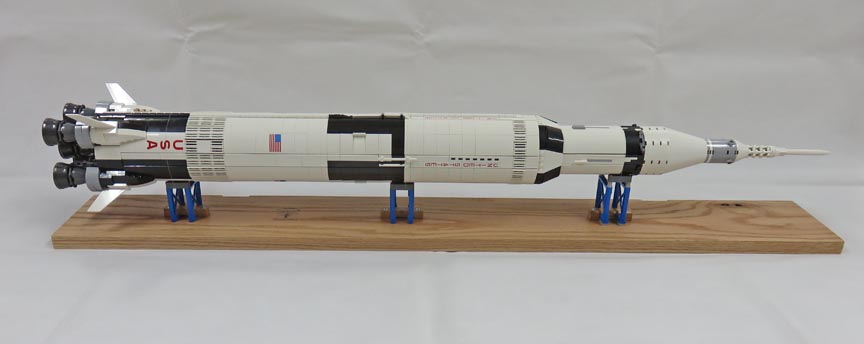
Here it is all finished, along with some facts and figures about the
actual rocket.
Size and Weight of the Saturn V:
Height: 363 ft. taller than the Statue of Liberty.
Fully fueled weight: 6.2–6.5 million pounds.
|
|
 |
Power and Thrust:
Liftoff thrust: 7.6 million pounds of force.
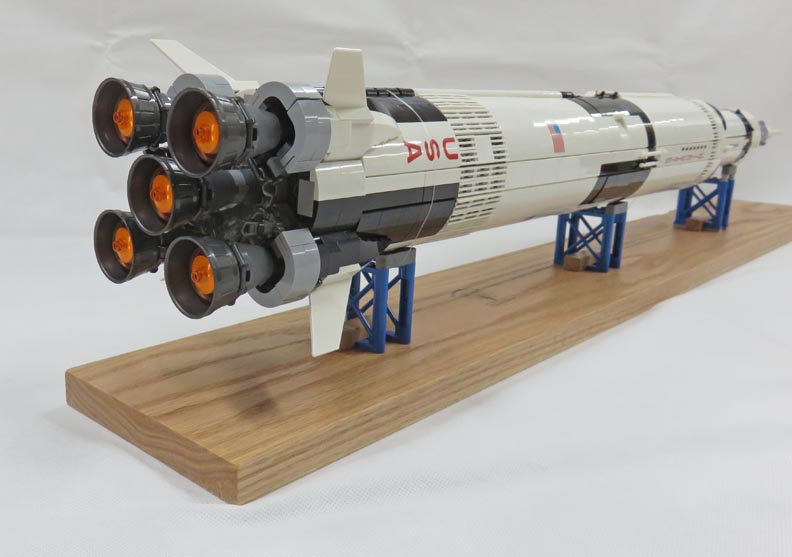
Each of the five F‑1 engines produced 1.5 million pounds of thrust,
burning 3 tons of propellant per second.
The F‑1 turbopump alone generated 55,000 horsepower, more than a
nuclear submarine.
Engineering Challenges
Combustion instability in the F‑1 engines was solved by detonating small
bombs inside the combustion chamber during tests to study flame behavior, an example of “engineering by controlled destruction.”
|
|
|
The Abort System
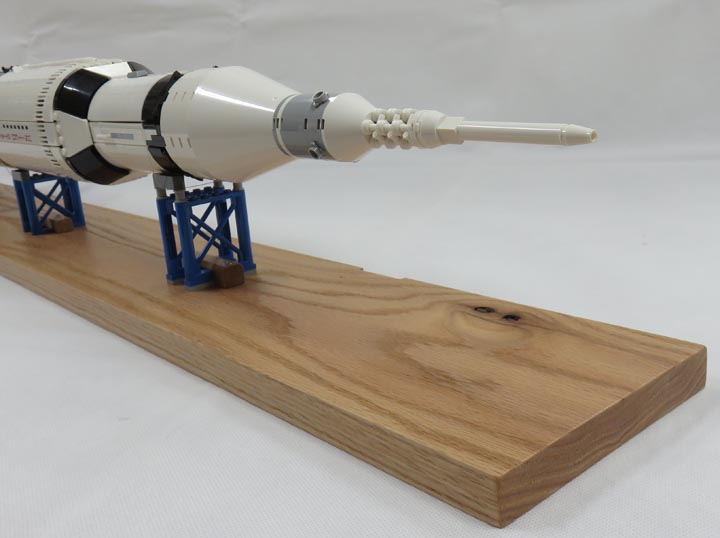
The Saturn V’s abort system was called the Launch Escape System (LES) — a
brutally powerful, purpose‑built rocket mounted on top of the Apollo
Command Module. Its only job was to yank the astronauts away from a
failing Saturn V in a fraction of a second.
The LES
consisted of four major components:
Launch Escape Tower — the long, truss-like tower on top of the capsule.
Escape Motor — a solid rocket producing 147,000 lb of thrust to pull
the capsule away.
Pitch Control Motor — small motors that tipped the capsule “nose down”
so it would arc away from the Saturn V.
Jettison Motor — used to discard the tower once it was no longer needed.
It was essentially a rocket on top of a rocket, designed to overpower
the Saturn V’s acceleration instantly.
When It Could Be Used:
The LES protected astronauts during,
1. Pad Abort: If the Saturn V caught fire or exploded on the pad, the
LES would fire and pull the capsule away at 15–20 g.
Apollo had a pad abort test (PA‑1) that proved this worked.
2. Early Ascent Abort: During the first 2 minutes of flight, the LES
could pull the capsule clear of the Saturn V’s plume and debris.
3. Mode II / Mode III Aborts: As the rocket climbed, the LES could still
be used until the vehicle reached thinner atmosphere. After tower
jettison, the Service Module engine handled aborts.
How Violent Was It: The LES was the most aggressive abort system ever
flown. It accelerated the capsule faster than the Saturn V itself. The
escape motor burned for only a few seconds but produced enough thrust to
throw the capsule a mile away almost instantly. Astronauts trained for
the g‑loads, but everyone agreed if it ever fired for real, it would be
the worst ride of your life, but you’d survive.
Why Saturn V Never Needed It:
Across 13 Saturn V launches, the LES was never used in an actual
emergency. The Saturn V’s reliability record is one of the reasons
Apollo succeeded.
|
|
|
Payload Capacity
To Low Earth Orbit: 310,000 pounds - still the largest payload ever
delivered to low earth orbit.
Towards the Moon (Trans Lunar Injection): 95,900 pounds.
|
|
|
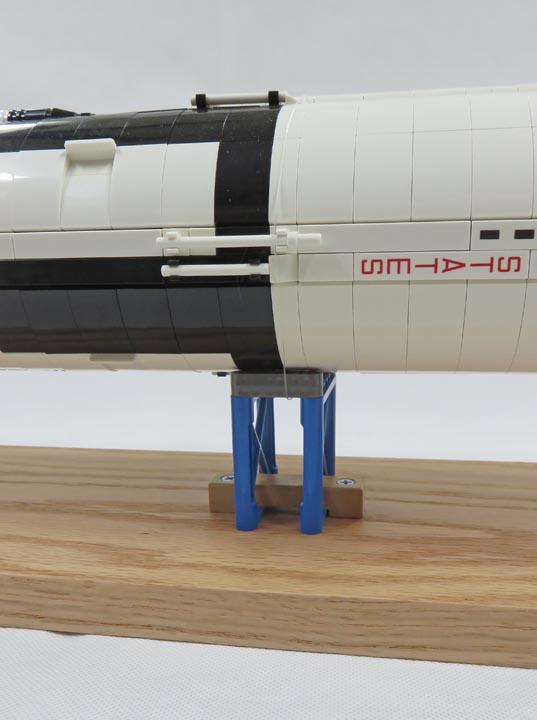
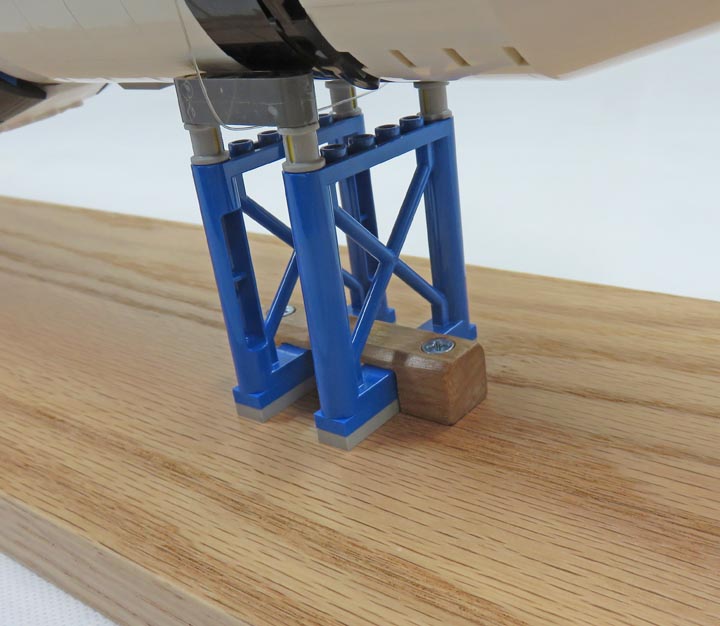
Here you can see a close-up of the clamps holding down
the stands.
Launch Record
Total launches: 13 (1967–1973).
Success rate: 100% payload delivery, with one partial failure (Apollo
6).
Crewed lunar missions launched: 9, sending 24 astronauts beyond Earth
orbit.
Historic Missions
Apollo 8: First crewed mission to orbit the Moon.
Apollo 11: First human Moon landing (1969).
Skylab: Final Saturn V launch placed America’s first space station into
orbit.
|
|
|
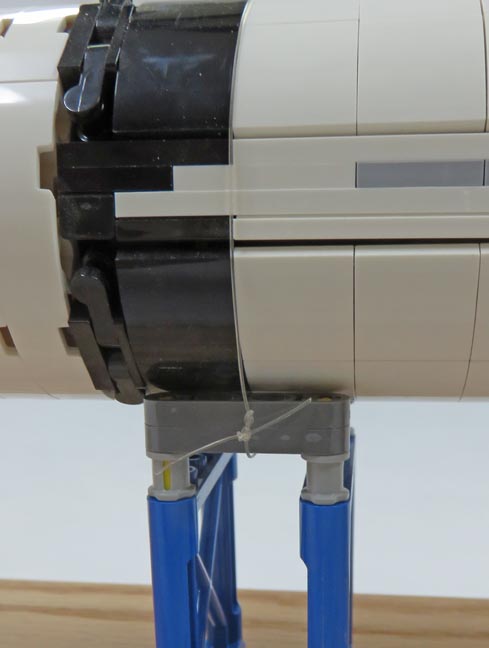
I put the knots of the fishing line on the backside of
the rocket.
Manufacturing and Logistics
First stage built by Boeing (New Orleans).
Second stage by North American Aviation (Seal Beach, CA).
Third stage by Douglas Aircraft (Huntington Beach, CA).
Massive components were shipped by barge through the Panama Canal to
Cape Kennedy.
|
|
|
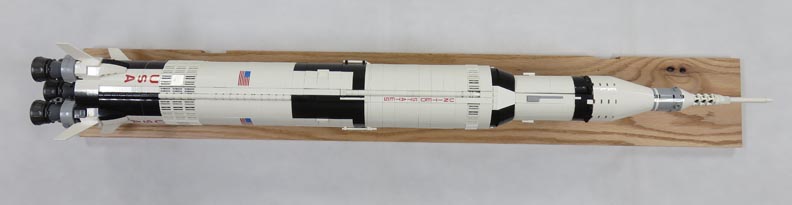
Staging and Engines:
The Saturn V had three liquid-fueled stages:
S‑IC first stage: 5 × F‑1 engines, LOX/RP‑1.
S‑II second stage: 5 × J‑2 engines, LOX/LH.
S‑IVB third stage: 1 × J‑2 engine, which restarts for lunar injection.
|
|
|
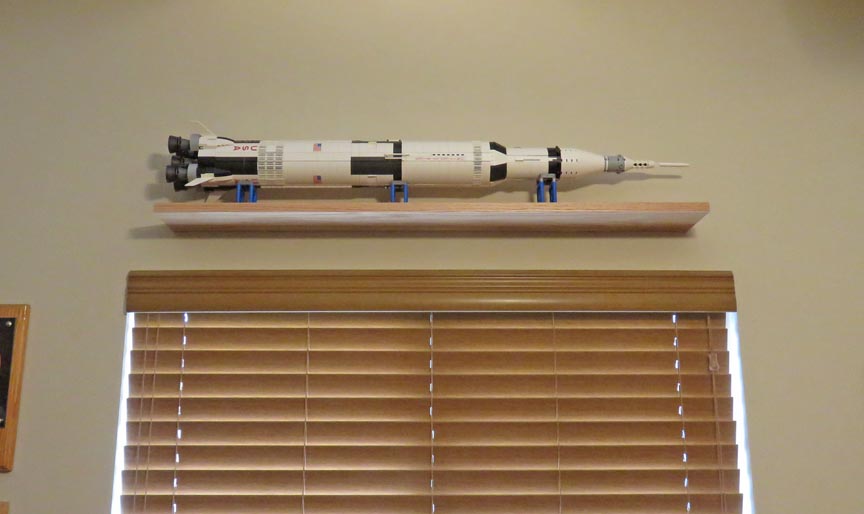
Here it is resting on it's shelf in my office. This
was a quick and easy project but it was also a fun one to build.
Legacy
The Saturn V remains the benchmark for super-heavy rockets; only NASA’s
SLS or Space Launch System, has since carried humans beyond low earth
orbit. Three unused Saturn V rockets survive in museums today. Ending
production and destroying tooling is widely considered one of NASA’s
greatest strategic mistakes, forcing later heavy‑lift programs to start
from scratch.
|
 |
|
1
2
3
4 |
|

